Carrot, Pumpkin, and Vegetable Baby Food Texture: What Process Teams Can Control
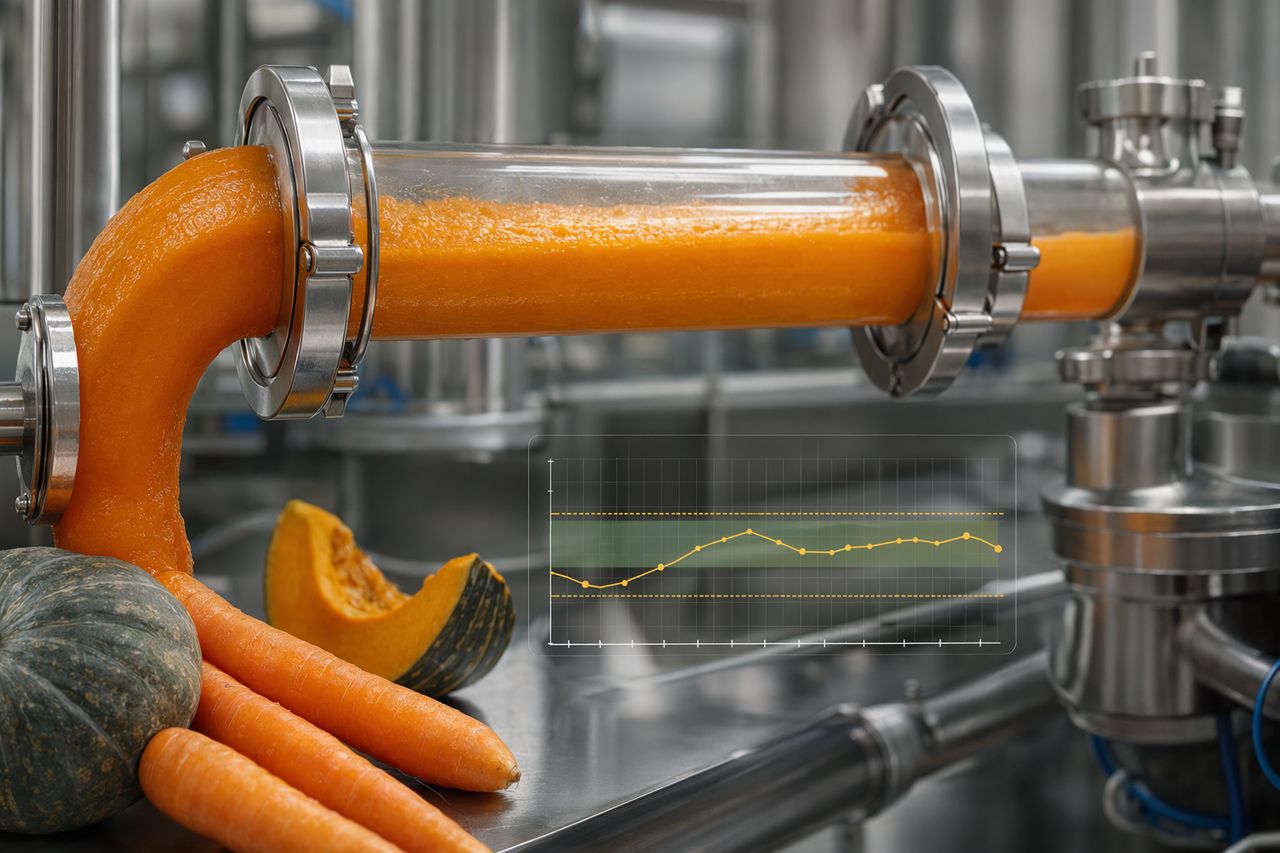
Carrot, pumpkin, squash, pea, and mixed vegetable baby foods can look simple on the shelf. On the plant floor, they are sensitive systems: fiber structure, soluble pectin, starch behavior, air incorporation, shear history, and thermal load all influence the final spoon texture.
For a process manager, the challenge is not only making a puree smooth once. It is making it smooth repeatedly, with predictable viscosity, stable filling behavior, clean filtration where needed, and a texture profile that holds through thermal processing and storage.
VelvetYield supports puree processors as an enzyme supplier for fruit puree processing and adjacent vegetable baby food applications, helping plants tune enzymatic pretreatment around real production constraints: raw material variation, pumpability, screen loading, yield, and batch-to-batch reliability.
Why vegetable baby food texture changes before the retort or aseptic step
Many texture issues are already built into the batch before final thermal processing. By the time a puree reaches the filler, upstream decisions have affected particle size, water binding, viscosity, and the way the product responds to heat.
Common causes include:
- Raw material maturity variation: older carrots or pumpkins may contain firmer cell wall material and less uniform solids distribution.
- Inconsistent cooking or blanching: under-softened tissue resists breakdown; over-softened tissue may create watery separation.
- Uneven milling or pulping: large fibrous particles create gritty mouthfeel and inconsistent screen behavior.
- High shear at the wrong stage: excessive shear can reduce body or trap air, depending on the matrix.
- Poorly controlled enzyme contact: too little pretreatment may leave viscosity too high; too aggressive a treatment may thin the puree beyond target.
- Air pickup before holding: entrained air affects filling accuracy, oxidation control, and apparent texture.
Texture control starts with mapping which of these variables your line can actually adjust.
The role of enzymes in carrot, pumpkin, and vegetable puree systems
Vegetable baby food matrices contain a mix of pectin-rich tissue, insoluble fiber, hemicellulose, and, in some vegetables, starch-containing solids. Enzymes can help modify these structures in a controlled way before thermal inactivation.
In practical plant terms, the goal is usually not to make the product thin. The goal is to make the product manageable.
Enzymatic pretreatment can support:
- Lower peak viscosity during transfer and holding
- More consistent puree flow into screens, finishers, or deaerators
- Improved release of entrained liquid from vegetable tissue
- Reduced fibrous drag in pumps and lines
- More predictable filling behavior
- A smoother texture without over-shearing the product
For baby food, the enzyme program must be designed around food safety, sensory targets, validated process windows, and complete downstream inactivation. VelvetYield works with processors to match enzyme type and addition point to the actual production sequence, not to a generic laboratory assumption.
Upstream control points that shape final texture
1. Raw material sorting and cut size
Large swings in trim quality, peel carryover, and cut size create inconsistent heat transfer and milling response. A uniform cut improves softening and reduces the need for aggressive mechanical breakdown later.
Process teams should track:
- Incoming variety and maturity
- Dry matter trend by lot
- Cut size distribution
- Peel, stem, seed, or fiber carryover
- Hold time before cooking
The more variable the raw material, the more important it is to use a flexible enzyme and process window rather than a fixed recipe that assumes every batch behaves the same.
2. Cooking or blanching before enzyme contact
Heat treatment changes cell wall permeability and tissue firmness. If vegetable particles remain too firm, enzymes may contact the surface without reaching enough of the internal structure. If the cook is too intense, the puree may become fragile, watery, or prone to separation.
A stable pretreatment sequence should define:
- Target softening point before milling
- Whether enzyme addition occurs before or after primary size reduction
- Mixing intensity during enzyme contact
- Hold time that fits production rhythm
- Thermal stop point before final processing
This is where plant-floor practicality matters. A technically perfect enzyme window that disrupts the schedule will not last in production.
3. Milling and particle size management
Smooth baby food texture depends on both particle size and particle character. Two purees can pass through the same screen and still feel different if one contains elastic fibers while the other contains well-softened vegetable tissue.
Enzymes can help reduce fibrous resistance, but they should not be used to compensate for poor milling setup. The best results usually come from combining:
- Consistent pre-softening
- Controlled enzyme contact
- Appropriate finisher screen selection
- Limited unnecessary recirculation
- Gentle transfer after final texture is achieved
This helps reduce the risk of over-processing, where the batch loses body while still retaining detectable coarse particles.
4. Viscosity before thermal processing
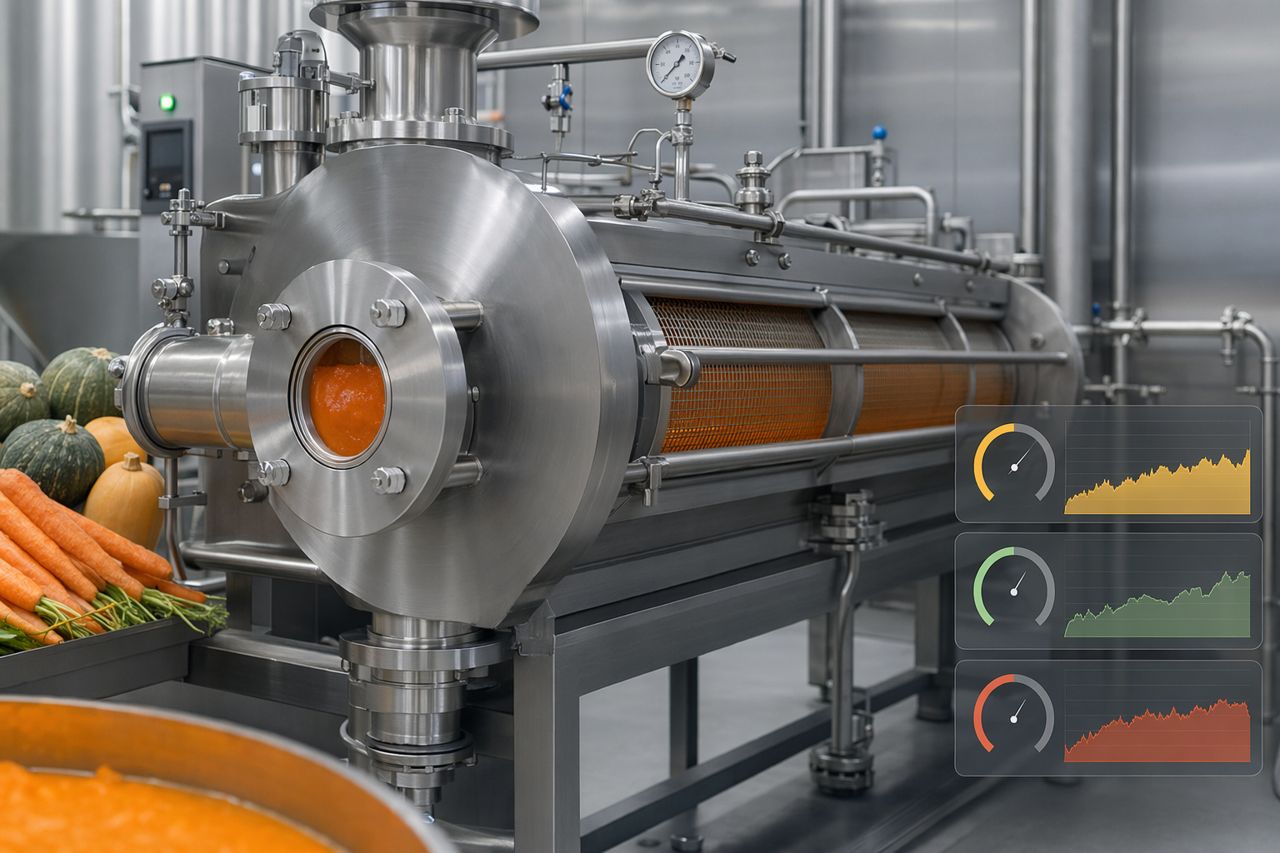
Viscosity affects more than mouthfeel. It influences heat transfer, deaeration, pump load, filling accuracy, and how consistently a batch moves through the line.
For carrot, pumpkin, and vegetable baby food, process teams often aim for a stable operating band rather than the lowest possible viscosity. A good enzyme program should help the puree enter that band with fewer corrections.
Useful plant indicators include:
- Pump amperage trend during transfer
- Screen pressure or loading behavior
- Deaerator stability
- Filler weight variation
- Hold tank turnover time
- Operator adjustments needed per batch
These signals often reveal texture risk earlier than final sensory checks.
What to avoid: texture fixes that create new problems
When a batch is too thick, the quickest correction can be tempting: more water, more shear, longer recirculation, or a wider process deviation. Each can create downstream consequences.
Common tradeoffs include:
- Water addition may reduce viscosity but dilute flavor, color, and solids targets.
- Extra shear may smooth coarse particles but reduce natural body.
- Longer holding may improve flow but increase schedule pressure and thermal history.
- Over-treatment may create a puree that fills easily but lacks the desired spoon texture.
A controlled enzyme approach is most valuable when it reduces these corrective actions rather than adding another variable for operators to chase.
Documentation matters in baby food production
Baby food processors need more than a functional ingredient. They need supplier support that fits procurement, quality, regulatory, and production expectations.
When evaluating an enzyme supplier, ask for:
- Food-grade suitability documentation
- Allergen and dietary status information where applicable
- GMO-status statement where required by the market
- Heavy metals and contaminant control information
- Country-of-origin and traceability support
- Recommended storage and handling guidance
- Process guidance for inactivation and validation
- Batch-to-batch quality consistency
VelvetYield provides practical technical support so the enzyme program can be reviewed by quality teams and used confidently by production teams.
A practical trial plan for vegetable baby food texture
A useful plant trial should connect enzyme use to measurable production outcomes, not just a bench observation.
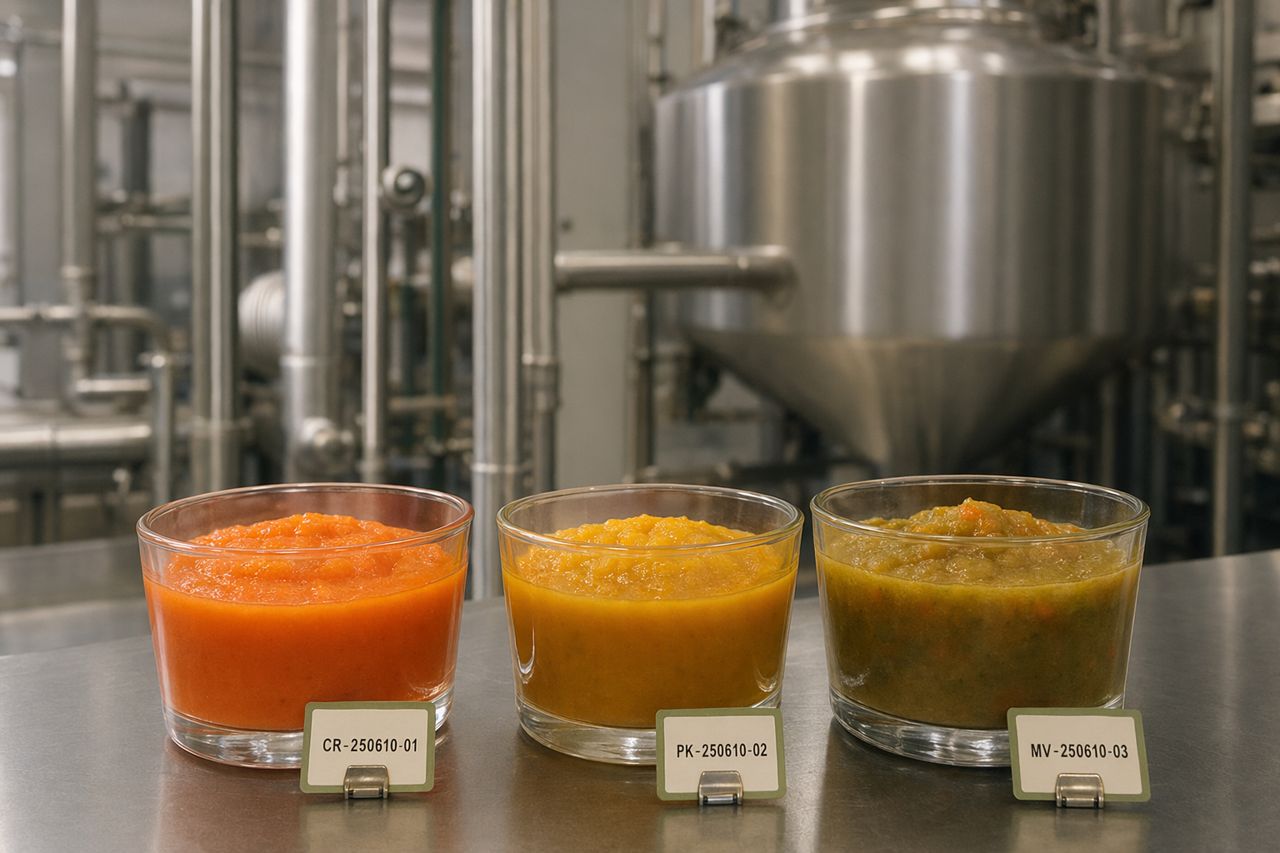
Start with one product family, such as carrot-pumpkin blend or squash-carrot puree, and compare the current process against a controlled enzyme-assisted run.
Track before and after:
- Raw material lot details
- Cook or blanch conditions
- Milling setup
- Enzyme addition point
- Mixing and holding conditions
- Transfer behavior
- Screen or finisher loading
- Deaeration response
- Filler stability
- Final texture panel notes
- Post-thermal texture retention
The goal is to identify the narrow set of controls that actually drive improvement. Once those controls are clear, the process can be scaled across similar vegetable blends.
Where VelvetYield fits
VelvetYield supplies enzyme solutions for puree plants that need better control over viscosity, yield, texture, filtration behavior, and batch reliability. For vegetable baby food, we help process teams evaluate whether enzymatic pretreatment can support smoother flow and more consistent texture before thermal processing and filling.
Our approach is calm and practical:
- Understand the raw material and product target
- Review the current process sequence
- Select an enzyme strategy that fits the line
- Define trial conditions production can actually run
- Support comparison against plant KPIs
- Help document the selected process window
The result is not a one-size-fits-all additive recommendation. It is a controlled processing tool designed around your puree, your equipment, and your quality expectations.
Request a quote
If your team is working on carrot, pumpkin, squash, pea, or mixed vegetable baby food texture, VelvetYield can help you evaluate an enzyme program for your line.
Request a quote using the on-site form and include your vegetable base, current texture challenge, process stage, and target improvement. We will respond with a practical recommendation for your production context.